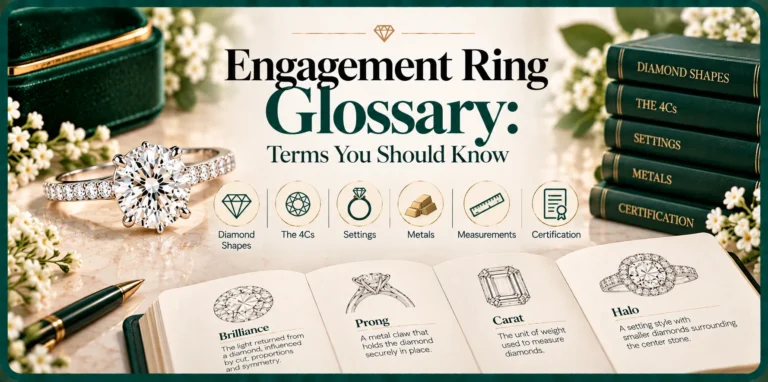
Buying an engagement ring brings new words into your life. These words include the 4Cs, carat weight, pavé, prongs, pavilion, symmetry and IGI certification. Knowing these words helps you compare diamonds read product descriptions and ask questions before you buy.
This engagement ring glossary tells you the useful words, about diamonds, rings, settings, certifications and shopping. It uses language so you can feel more confident when you explore engagement rings.
Diamond Basics and the 4Cs
4Cs
The 4Cs stand for Cut, Color, Clarity, and Carat Weight. These are the four primary characteristics used to describe a diamond’s quality and help determine its appearance and value.
Cut
Cut describes how well a diamond’s facets are proportioned and finished to interact with light. Cut is different from shape. A round, oval, or emerald diamond can each have different cut characteristics.
Color
Color measures how much color is visible in a white diamond. The standard scale runs from D, which represents the highest colorless range, through Z, where a noticeable yellow or brown tint can appear.
Clarity
Clarity refers to internal inclusions and surface blemishes visible under magnification. Grades range from Flawless through Included. An eye-clean diamond can have inclusions that are not noticeable to the naked eye.
Carat Weight
Carat weight measures a diamond’s weight. One carat equals 200 milligrams. Carat weight should not be confused with physical size because two diamonds with the same carat weight can have different measurements depending on their proportions and shape.
Diamond Shape
Shape describes the visible outline of a diamond, such as round, oval, pear, emerald, marquise, princess, cushion, radiant, Asscher, or heart.
Lab-Grown Diamond
A lab-grown diamond is a diamond created in a controlled environment using technologies such as CVD or HPHT. It has the same basic chemical composition and crystal structure as a diamond formed naturally, while its origin is different.
BUY RING
-
Diamond Engagement Ring Cushion Diamond Ring Unique 3 Diamond Wedding Ring Genuine Lab Grown Diamond Ring Anniversary Ring for Wife Gift
Price range: $378.00 through $2,905.00 Select options This product has multiple variants. The options may be chosen on the product page -
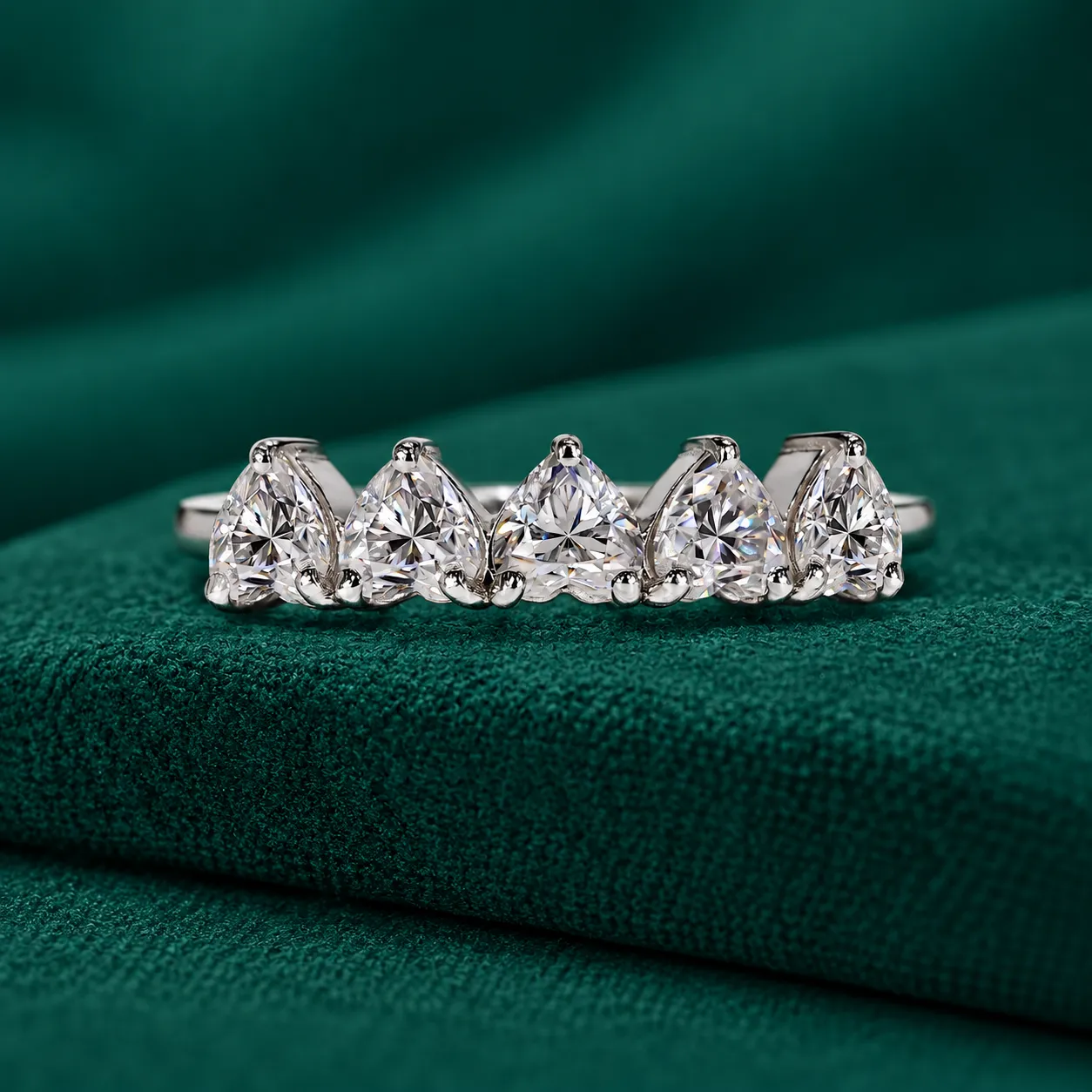
Heart Diamond Wedding Band Lab Grown Diamond Band 5 Stone Diamond Ring Solid Yellow Rose Gold Ring Anniversary Gifts for Wife Ring for Her
Price range: $619.00 through $1,159.00 Select options This product has multiple variants. The options may be chosen on the product page -
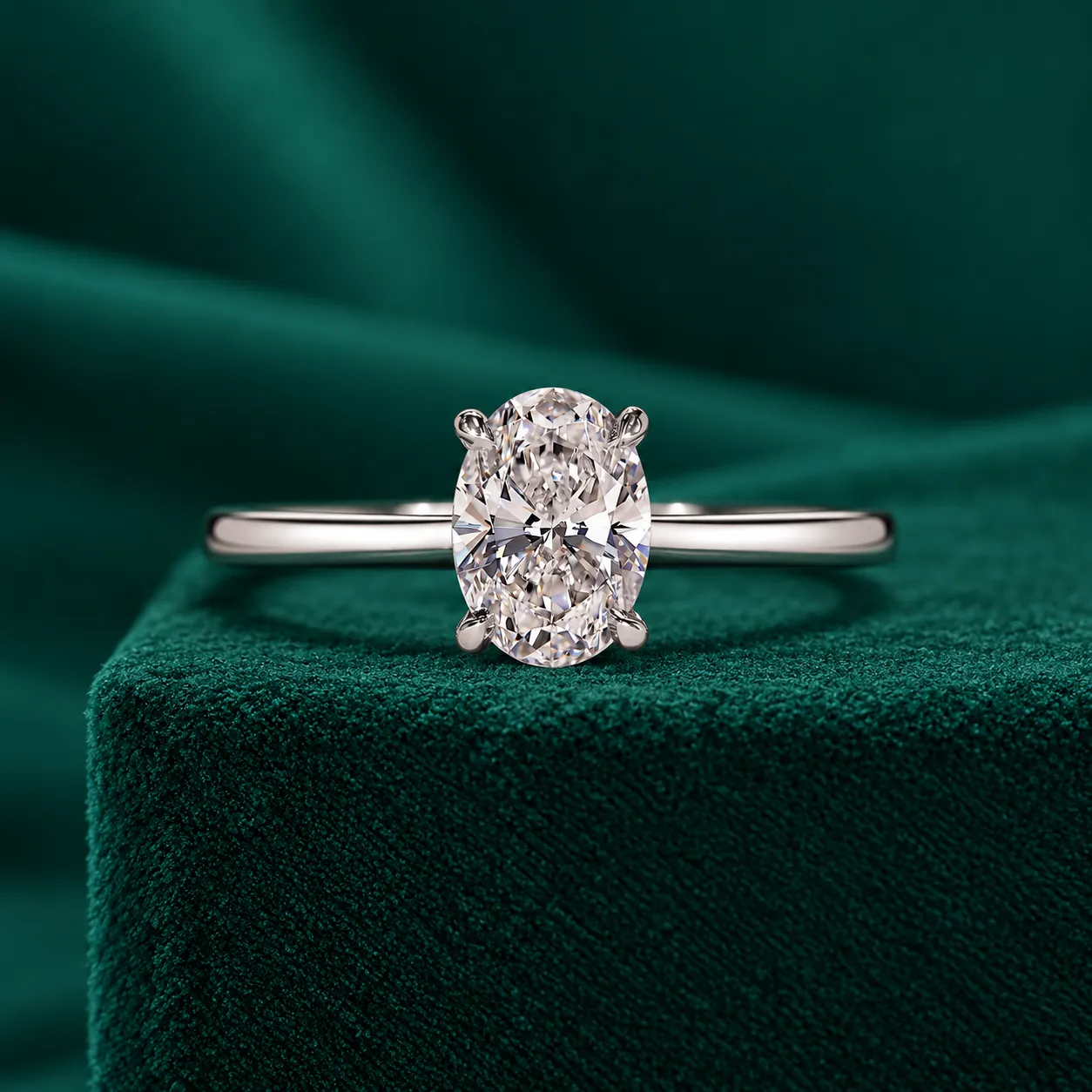
Oval Diamond Engagement Ring Lab Grown Diamond Ring IGI Certified Diamond Anniversary Ring Diamond Solitaire Ring Oval Proposal Ring for Her
Price range: $345.00 through $3,020.00 Select options This product has multiple variants. The options may be chosen on the product page -
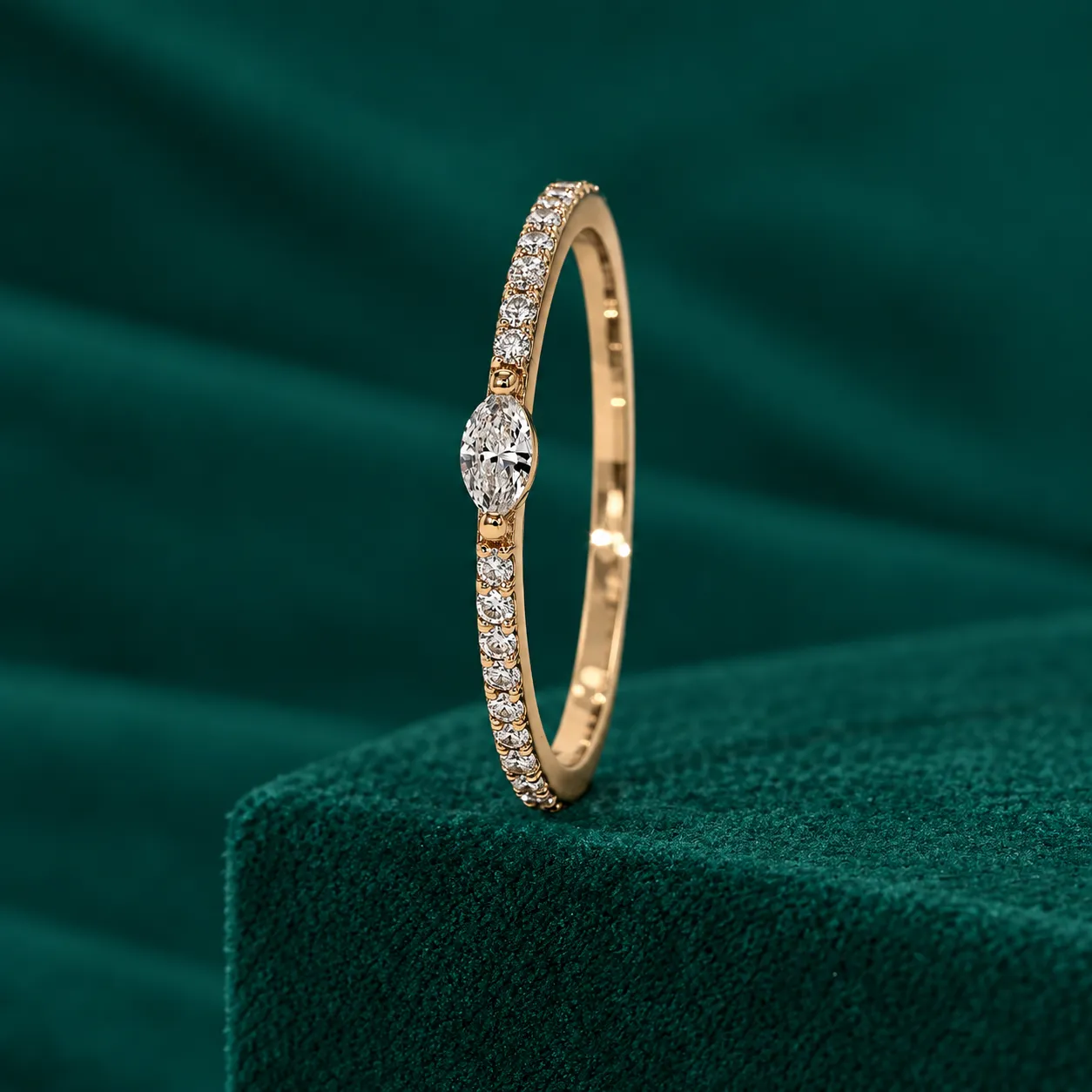
Tiny Marquise Ring Minimalist Engagement Ring for Her Women Simple Solitaire Ring Thin Marquise Cut Band Genuine Lab Diamond Promise Ring
Price range: $229.00 through $552.00 Select options This product has multiple variants. The options may be chosen on the product page
Diamond Sparkle and Light Terms
Brilliance
Brilliance refers to the white light returned from a diamond. It is strongly influenced by the diamond’s cut and proportions.
Fire
Fire describes flashes of spectral colors that can appear when white light is dispersed through the diamond’s facets.
Scintillation
Scintillation refers to the flashes and pattern of light and dark areas that appear as the diamond, the viewer, or the light source moves.
Fluorescence
Fluorescence describes a diamond’s reaction to ultraviolet light. It is commonly graded from None to Very Strong. In most everyday lighting, fluorescence may not be noticeable.
Eye-Clean
Eye-clean is an informal term used for a diamond whose inclusions are not visible to the naked eye at normal viewing distance. It is not a formal grading-report grade.
Bow-Tie Effect
The bow-tie effect is a darker area that can appear across the center of some elongated diamond shapes, particularly oval, pear, and marquise diamonds. Its appearance can vary from one diamond to another.
Diamond Anatomy Terms
Table
The table is the large, flat facet on the top of a diamond. Table percentage compares the table’s width with the diamond’s average girdle diameter.
Crown
The crown is the upper section of the diamond above the girdle. Its facets play an important role in how light enters and exits the stone.
Pavilion
The pavilion is the lower section of a diamond below the girdle. Pavilion proportions influence how efficiently light is reflected back toward the viewer.
Girdle
The girdle is the narrow section around the widest part of a diamond, separating the crown from the pavilion. Its thickness can range from extremely thin to extremely thick.
Culet
The culet is the small facet or point at the bottom of a diamond. Modern diamonds commonly have a culet graded as none.
Depth Percentage
Depth percentage compares the diamond’s total height with its average girdle diameter. It is one of the measurements shown on many diamond grading reports and can affect the diamond’s appearance.
Length-to-Width Ratio
The length-to-width ratio compares a diamond’s length with its width. It is particularly useful when comparing elongated shapes such as oval, emerald, pear, and marquise diamonds.
Engagement Ring Shapes
Round Diamond
A round diamond has a circular outline and is commonly associated with the classic brilliant-cut appearance.
Oval Diamond
An oval diamond has an elongated outline while retaining many characteristics associated with a brilliant-style cut. Its proportions can influence how elongated or rounded it appears.
If you are specifically exploring this shape, an Oval Lab Grown Diamond Engagement Ring can be a useful option to consider when comparing elongated engagement ring designs.
Emerald Cut
An emerald-cut diamond has a rectangular outline with step-cut facets. It creates a different visual effect from the intense facet pattern of a brilliant cut.
Marquise Diamond
A marquise diamond has an elongated shape with pointed ends. Its length can create a visually elongated appearance on the finger.
Pear Diamond
A pear diamond combines a rounded end with a pointed tip, creating a distinctive teardrop-like outline.
Princess Cut
A princess-cut diamond generally has a square or rectangular outline with angular corners and brilliant-style faceting.
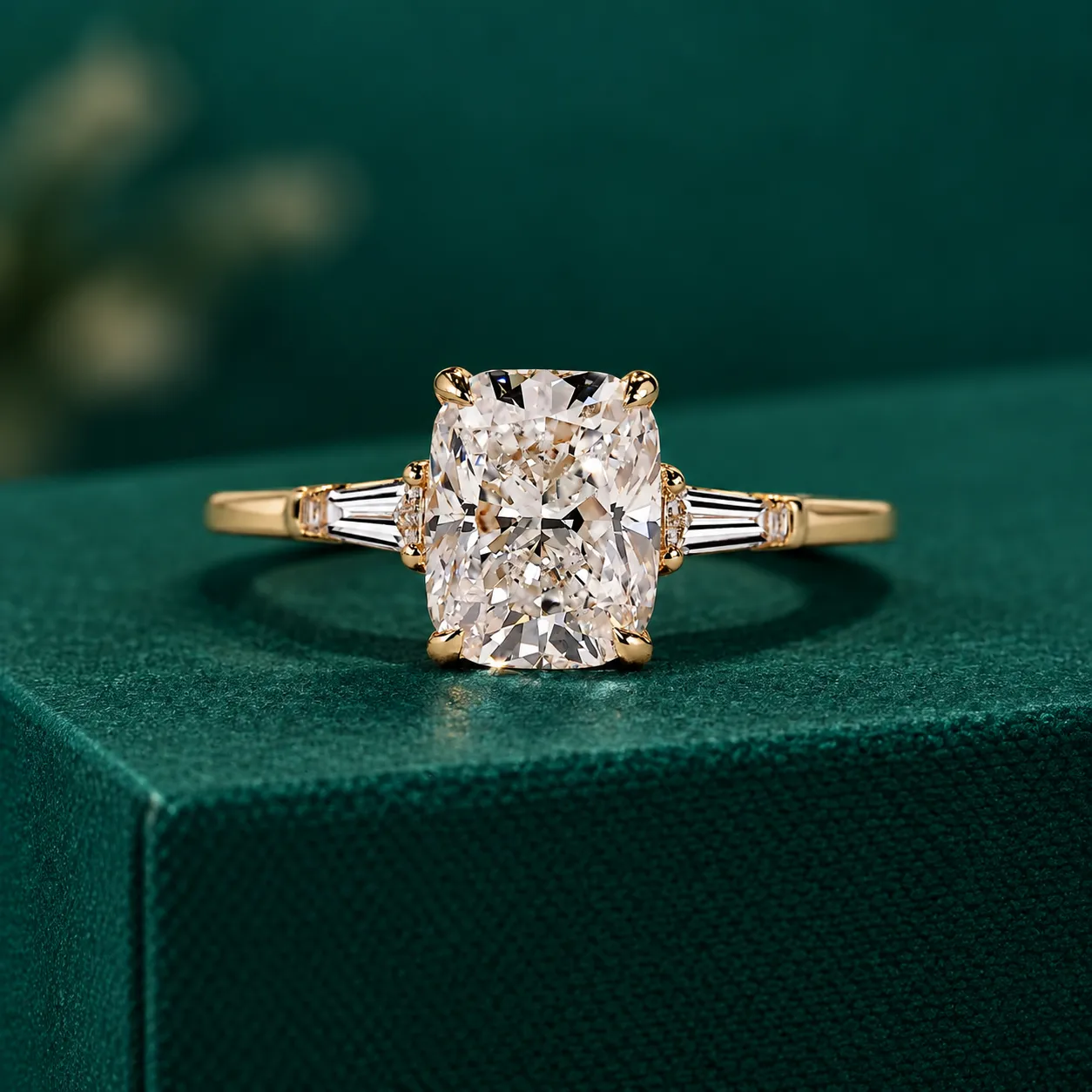
Cushion Cut
A cushion-cut diamond typically has a square or rectangular outline with rounded corners, giving the shape a softer appearance.
Radiant Cut
A radiant-cut diamond combines a rectangular or square outline with brilliant-style faceting.
Ring Settings and Structure
Setting
The setting is the metal structure that holds the diamond or diamonds in place. Setting design affects the ring’s appearance, security, and overall profile.
Prong
Prongs are small metal claws that hold a center diamond in place. Four- and six-prong designs are common examples.
Bezel Setting
A bezel setting surrounds the diamond’s perimeter with a metal rim. This creates a more enclosed appearance around the stone and can provide additional protection around its edges.
Pavé
Pavé, pronounced “pa-VAY,” refers to small diamonds set closely together along the band with relatively little visible metal between them. The result is a continuous-looking surface of sparkle.
Halo
A halo is a circle or arrangement of smaller diamonds surrounding a center stone. It can add additional sparkle and increase the visual presence of the center diamond.
Solitaire
A solitaire engagement ring features one primary center diamond without additional side stones competing for attention. It is one of the most recognizable engagement ring styles.
Three-Stone
A three-stone ring features a center diamond accompanied by two side stones. The design is traditionally associated with past, present, and future.
Shank
The shank is the portion of the ring band that wraps around the finger. It can be plain, diamond-set, split, twisted, or designed in other ways.
Accent Stones
Accent stones or side stones are smaller diamonds used to complement the center diamond or add additional sparkle to the ring.
BUY RING
-
Diamond Engagement Ring Cushion Diamond Ring Unique 3 Diamond Wedding Ring Genuine Lab Grown Diamond Ring Anniversary Ring for Wife Gift
Price range: $378.00 through $2,905.00 Select options This product has multiple variants. The options may be chosen on the product page -
Heart Diamond Wedding Band Lab Grown Diamond Band 5 Stone Diamond Ring Solid Yellow Rose Gold Ring Anniversary Gifts for Wife Ring for Her
Price range: $619.00 through $1,159.00 Select options This product has multiple variants. The options may be chosen on the product page -
Oval Diamond Engagement Ring Lab Grown Diamond Ring IGI Certified Diamond Anniversary Ring Diamond Solitaire Ring Oval Proposal Ring for Her
Price range: $345.00 through $3,020.00 Select options This product has multiple variants. The options may be chosen on the product page -
Tiny Marquise Ring Minimalist Engagement Ring for Her Women Simple Solitaire Ring Thin Marquise Cut Band Genuine Lab Diamond Promise Ring
Price range: $229.00 through $552.00 Select options This product has multiple variants. The options may be chosen on the product page
Grading and Certification Terms
Grading and Certification Terms
Diamond Grading Report
A diamond grading report documents characteristics such as the diamond’s 4Cs, measurements, proportions, polish, symmetry, and other grading information.
IGI Certification
IGI certification refers to a diamond grading report issued by the International Gemological Institute. IGI reports for lab-grown diamonds can provide information about the diamond’s characteristics and grading.
Polish
Polish describes the quality and smoothness of a diamond’s facet surfaces after cutting and finishing.
Symmetry
Symmetry describes how accurately the diamond’s facets are aligned and proportioned relative to one another.
Measurements
Measurements describe the physical dimensions of the diamond, generally expressed in millimeters. They help buyers understand the actual proportions and face-up dimensions of a stone.
Diamond Inscription
A diamond inscription is microscopic text or identification placed on the diamond’s girdle. When applicable, it can correspond with information on the grading report.
Metal and Ring Terms
10K, 14K, and 18K Gold
These terms describe the proportion of pure gold in a gold alloy. 10K, 14K, and 18K gold differ in gold content and can also differ in color, hardness, and other characteristics.
White Gold
White gold is a gold alloy designed to have a white appearance. It may receive rhodium plating to create a brighter white surface.
Yellow Gold
Yellow gold retains the traditional warm gold appearance and is available in different karat levels.
Rose Gold
Rose gold is a gold alloy with a warm pink or reddish appearance created through its alloy composition.
Platinum
Platinum is a naturally white precious metal commonly used in fine jewelry and engagement rings. Platinum jewelry is often marked according to its purity, such as 950 platinum.
Engagement Ring Shopping Terms
Total Carat Weight
Total Carat Weight (TCW) refers to the combined carat weight of all diamonds or gemstones in a piece of jewelry. It should not be confused with the carat weight of the center diamond alone.
Center Stone
The center stone is the primary diamond or gemstone that forms the focal point of an engagement ring.
Ring Size
Ring size indicates the measurement used to determine how a ring fits around the finger. Proper sizing is important for both comfort and security.
Resizing
Resizing refers to adjusting a ring so it fits a different finger measurement. Whether and how much a ring can be resized depends on its design and construction.
Custom Engagement Ring
A custom engagement ring is designed or modified according to specific preferences rather than selected entirely from a standard design.
Understanding these terms can make the actual buying process much easier. Once you know what words such as cut, clarity, setting, certification, and total carat weight mean, you can compare products with more confidence.
For a broader collection of common buyer questions, you can also explore the Complete Engagement Ring FAQ. And when you’re ready to move from terminology to the actual purchasing process, the Engagement Ring Shopping Roadmap can help you understand the major steps from setting a budget to choosing the final ring.
Final Thoughts
Choosing the right engagement ring comes down to personal style, diamond quality, and budget. From solitaire and halo to vintage and minimalist designs, every style offers something unique.
Explore our Complete Engagement Ring FAQ and Engagement Ring Glossary: Terms You Should Know for helpful buying tips and diamond terminology.
At FineImperial, discover lab-grown diamond engagement rings that celebrate your love with timeless elegance.